Thursday, 29 January 2015

Managing programmers and the programming mother******* mentality

I came across the following great site on Stumbleupon today - programming-motherfucker.com - and as a developer had a great laugh before realising that in my day job I'm really the guy the site is having a swipe at!

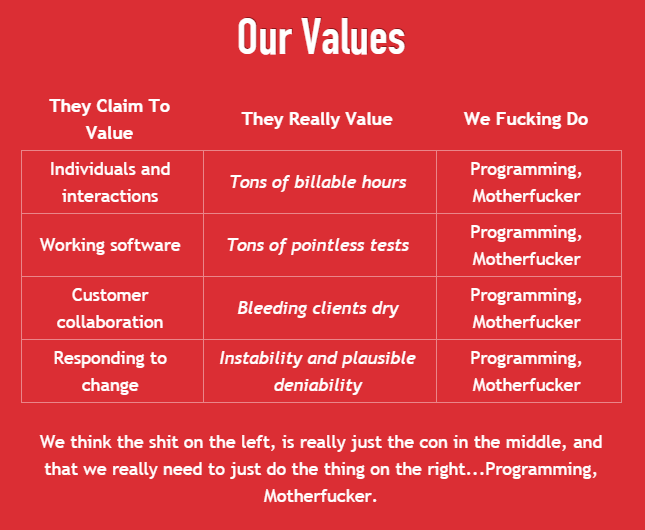
The site aims it's gun firmly at the door of managers, whether they practice agile, XP, Scrum, waterfall etc and pokes fun at the agile manifesto:

Screenshot of the alternative manifesto from http://programming-motherfucker.com/ 
Whilst the site may be a bit tongue in cheek (obviously taking inspiration from Pulp Fiction), a huge challenge of managing developers can be the fact they can see you as a roadblock in the way of them producing code. Ultimately you are responsible for the success or failure of a project and as a result you have probably applied a process to the team to help you ensure your team are progressing in the correct direction. So how, as a manager, can you break down this perception from members of your team who have this mentality?

Before I start, I'll confess when I started my first programming job I agree 100% with the sentiment of this site - I thought the people managing me had crazy processes which did nothing but slow me down. Over time and as I progressed through the ranks, I guess my mentality has changed - that or I've been broken by managers ;-)

Firstly put your cards on the table and explain why a certain process is in place. If you are transparent and can explain why you have a process - truthfully - then you will gain respect. If you use a tool like JIRA or Rally to manage workload, explaining that its really to help you manage people's workload and help plan releases and how their use of these tools allow you to do that will at least help them understand. The key here is to ensure that firstly the admin they are required to do is as little and efficient as possible, and secondly to get their input into the process and how they think it could change to make their work easier. At the end of the day a business and jobs survives because it makes money, if someone cannot accept that then you shouldn't employ them anyway.

The second thing which really really helps, is to be good technically in the first place. If you are not only a manager, but a good programmer (mother******) then they wont feel like you are bullshitting them. I talk about this in my post can someone from a non-technical background manage a team of programmers?

You have to accept that you can't force people to do something, if you want them to do it well. Unit tests are a great example; you can force people to do them but they'll end up writing rubbish tests. If the programmers are engaged in why the team wants unit tests, then they'll write good tests.

The last thing you should do, is look at the table above and work out where you currently sit - are you closer to the "They Claim to value" column or the "They Really Value" column. If you are to the right, you should look at what you can do to move to the left. Have you gone too far in trying to manage the team that you have actually moved away from the basic principles?

It's an interesting topic - how do you deal with programmers who have this attitude? If you are a programmer what do you think managers can do to be more effective?

Monday, 26 January 2015

Top 5 tips for when interviewing developers

Interviewing can be a stressful experience, not only for the interviewee! However, having a plan in place for how you want the interview to go and a set of good questions will take a lot of stress out of the experience.

1. Know what you are looking for before the interview.


You are hiring for a reason. You have a position to fill and probably a specific skills gap you are trying to fill. Write down the top 5 skills you need, what behaviours you expect from the person, what experience you expect etc. This should have been done at the CV sifting stage but it's still worth having clear in your head before the interview. 


2. Start the interview with technical questions on the top 5 skills you require.

They are in the interview as their CV has noted the key skills you are seeking - so start off (maybe after a welcome and explaining the process) with a few questions on these key skills. Make sure you know what answers you are expecting. A good candidate will answer these questions with ease, and more importantly will help them relax which helps with the rest of the interview. If the candidate doesn't know the answers, then you should try (within reason) to help get them to the answer you are looking for. If you can't - move on.

Note: at this stage, if a candidate has not answered well you may already know the outcome of the interview. It can be tempting to end the interview early, but you can leave yourself in a tricky situation legally as all candidates deserve the same opportunity in terms of questions. Law in different countries (especially around equality etc) can be a minefield so if in doubt seek advice from a member of the HR department. 

3. Get the candidate to solve a problem.

There is nothing better than seeing someone in action to help you make a judgement call, so challenge them to do something. Some people ask the candidate to sit a practical programming test which is great, but can put a lot of potential candidates off. I find asking them to design on a whiteboard how they would tackle a problem is a far better and quicker option which allows you real insight into their problem solving skills.

When asking them to design something, how about a simplified version of the product you are working on? How would they architect it? Do they dive into the problem at a very low level or do they think about the high level problem and drill down? How do they react to you challenging their design? Can they accept criticism and adapt their design, or can they defend their design and convince you they are right? Offer to work with them after a while and see how they collaborate and interact with you. This simple exercise (only needs to take 10-15 minutes) is in my opinion the best way to separate the good candidates from the bad. You may also learn something yourself from it! If you don't want to ask them to design your current product, why not try something everyone knows, like a board game such as checkers, chess or monopoly.

Asking candidates to design a board game can give you a great insight into how they work and approach problems.


4. Hire better than what you already have, and different to what you already have.

This one is simple, but it's amazing how many people (bad managers) fall into this trap. You need to hire better people than you have/you are if the company is going to grow and your projects are going to be successful. Bad managers are scared that they will be outshone by the people they are hiring; the opposite is true - your projects will be more successful and your own reputation will grow. Soon you will be heading up more recruitment as you have a proven track record. Additionally, you will get to know most new starts who will have instant respect for you due to the fact you interviewed them. James Caan goes into detail on this here.

Diversity is also key; just because someone works or thinks differently to your or your current staff doesn't mean they are doing it wrong. Different approaches and views are always good and can help to provide the best solutions, so long as the person can collaborate and defend their decisions; but you will know that from point 3 above!

5. Ask how they keep their skills up to date.

Last but not least, good developers keep their skill sets up to date. Ask them how they do this? Do they read textbooks or blogs or both? Do they attend conferences or take part in hackathons? Don't expect everyone to do all of these, just one will do. However, someone who doesn't do one of these is a big warning sign for me that they lack the drive to keep improving and learning. Would you want someone not up to date in the latest technology and trends to be designing your next product?

This again can be a great opportunity to learn about new blogs or books that you should check out. For senior hires, ask what they would recommend to a junior hire straight from University? Again, questions like this will give you an insight into how they may mentor junior members of the team.

That is my recipe for interviews and has worked for me pretty well, but there are always new techniques to learn so if you have any experiences you would like to share please leave a comment below.

Thursday, 22 January 2015

Real time Google Analytics on the go

As I mention in most of my blog posts analytics is a key part of product development with Google Analytics being the key player in the market. When doing an A/B test knowing who your users are, where they are, when and how they interact with your app, website or blog will help you make informed decisions.

Checking these stats is important so when should you do it? I try to check my stats on the train to work in the morning with using Googles own app.


Take 5 minutes and try and learn from the data in front of you. I frequently can identify mobile devices for example which my apps don't run properly on, as it causes very low duration times and high drop off rates. Maximising what you have is really important!

Saturday, 17 January 2015

[Book Review] - Technical Blogging by Antonio Cangiano

Title: Technical Blogging
Author: Antonio Cangiano
Publisher: Pragmatic Bookshelf
Publish Date: March 1, 2012

As part of my new years resolution to more blog more regularly I started reading this book on the train into work on my iPad, finishing it within a week. As I mentioned in my post last week this book is great and has been a real motivator for me to take my blogging more seriously.

Book cover - image taken from the Pragmatic Bookshelf

I highly recommend this book to anyone who is a keen blogger or even someone who has a website or app who wants to increase their exposure to their product as the tips given in the book are transferrable. Antonio Cangiano is the author of many blogs - most famously Zen and the art of Programming and Math-Blog so he know's what he's talking about.

The book covers the following key topics:
  • Determining what kind of blog you are running (personal, company, general, niche etc)
  • The technicalities on how to create a blog
  • Creating content and maintaining your pace of blogging
  • Promoting your blog
  • Making money from your blog
The book focusses mainly on the Wordpress platform, but most of it is transferrable to other platforms (e.g. I use Blogger). 

The big takeaway I took from the book which I could instantly put into action were tips on how to ensure your blog more regularly (e.g. have blog entries in reserve in case you suffer writers block) and how to make your blog reach more readers. It's amazing what can happen if you just publish your best content onto reddit for example.

Has the book made any measurable difference to my blog? YES! 
  1. My number of posts has increased dramatically. More importantly I have a backlog of potential blog posts ready to get out there.
  2. Previously my record number of page views in a day was 54. This week I had 2500 in one day! 
  3. I've started to contribute back to the programming community which feels really good. Reading and commenting on other people's contents helps broaden my knowledge and get me more enthused in the industry.
Well worth picking up for the motivation alone.

Thursday, 15 January 2015

Privacy Policy

This Privacy Policy governs the manner in which MacKenzie Software collects, uses, maintains and discloses information collected from users (each, a "User") of the http://www.mackenziesoftware.com/ website ("Site"). This privacy policy applies to the Site and all products and services offered by MacKenzie Software.

Personal identification information

We may collect personal identification information from Users in a variety of ways, including, but not limited to, when Users visit our site, subscribe to the newsletter, and in connection with other activities, services, features or resources we make available on our Site. Users may be asked for, as appropriate, email address. Users may, however, visit our Site anonymously. We will collect personal identification information from Users only if they voluntarily submit such information to us. Users can always refuse to supply personally identification information, except that it may prevent them from engaging in certain Site related activities.

Non-personal identification information

We may collect non-personal identification information about Users whenever they interact with our Site. Non-personal identification information may include the browser name, the type of computer and technical information about Users means of connection to our Site, such as the operating system and the Internet service providers utilized and other similar information.

Web browser cookies

Our Site may use "cookies" to enhance User experience. User's web browser places cookies on their hard drive for record-keeping purposes and sometimes to track information about them. User may choose to set their web browser to refuse cookies, or to alert you when cookies are being sent. If they do so, note that some parts of the Site may not function properly.

How we use collected information

MacKenzie Software may collect and use Users personal information for the following purposes:
  • - To improve customer service
    Information you provide helps us respond to your customer service requests and support needs more efficiently.
  • - To personalize user experience
    We may use information in the aggregate to understand how our Users as a group use the services and resources provided on our Site.
  • - To improve our Site
    We may use feedback you provide to improve our products and services.
  • - To send periodic emails
    If User decides to opt-in to our mailing list, they will receive emails that may include company news, updates, related product or service information, etc. If at any time the User would like to unsubscribe from receiving future emails, we include detailed unsubscribe instructions at the bottom of each email or User may contact us via our Site.
How we protect your information

We adopt appropriate data collection, storage and processing practices and security measures to protect against unauthorized access, alteration, disclosure or destruction of your personal information, username, password, transaction information and data stored on our Site.

Sharing your personal information

We do not sell, trade, or rent Users personal identification information to others. We may share generic aggregated demographic information not linked to any personal identification information regarding visitors and users with our business partners, trusted affiliates and advertisers for the purposes outlined above.We may use third party service providers to help us operate our business and the Site or administer activities on our behalf, such as sending out newsletters or surveys. We may share your information with these third parties for those limited purposes provided that you have given us your permission.

Third party websites

Users may find advertising or other content on our Site that link to the sites and services of our partners, suppliers, advertisers, sponsors, licensors and other third parties. We do not control the content or links that appear on these sites and are not responsible for the practices employed by websites linked to or from our Site. In addition, these sites or services, including their content and links, may be constantly changing. These sites and services may have their own privacy policies and customer service policies. Browsing and interaction on any other website, including websites which have a link to our Site, is subject to that website's own terms and policies.

Advertising

Ads appearing on our site may be delivered to Users by advertising partners, who may set cookies. These cookies allow the ad server to recognize your computer each time they send you an online advertisement to compile non personal identification information about you or others who use your computer. This information allows ad networks to, among other things, deliver targeted advertisements that they believe will be of most interest to you. This privacy policy does not cover the use of cookies by any advertisers.

Google Adsense

Some of the ads may be served by Google. Google's use of the DART cookie enables it to serve ads to Users based on their visit to our Site and other sites on the Internet. DART uses "non personally identifiable information" and does NOT track personal information about you, such as your name, email address, physical address, etc. You may opt out of the use of the DART cookie by visiting the Google ad and content network privacy policy at http://www.google.com/privacy_ads.html

Views Expressed in Blog
The views expressed in this blog are of MacKenzie Software only, and not that of anybody else including any current employers. MacKenzie Software is not responsible for views added to comments on this site, but will proactively monitor comments and remove any which are not acceptable.

Changes to this privacy policy

MacKenzie Software has the discretion to update this privacy policy at any time. When we do, we will post a notification on the main page of our Site, revise the updated date at the bottom of this page. We encourage Users to frequently check this page for any changes to stay informed about how we are helping to protect the personal information we collect. You acknowledge and agree that it is your responsibility to review this privacy policy periodically and become aware of modifications.

Your acceptance of these terms

By using this Site, you signify your acceptance of this policy. If you do not agree to this policy, please do not use our Site. Your continued use of the Site following the posting of changes to this policy will be deemed your acceptance of those changes.

Contacting us

If you have any questions about this Privacy Policy, the practices of this site, or your dealings with this site, please contact us at:
MacKenzie Software
http://www.mackenziesoftware.com/

This document was last updated on January 15, 2015
Privacy policy created by Generate Privacy Policy

Can someone from a non-programming background successfully manage or lead a team of programmers?

This is a question I have asked myself a few times over the last few years, and it can be a bit controversial:

Can someone from a non-programming background successfully manage or lead a team of programmers?

It's a good question. Of course, ultimately if you go up a few layers in an organization, the person at the top is invariably not from a programming background. I'm talking about direct leaders of the development team; the technical lead, the development manager, the scrum-master.

Over the years I've been managed by various different people from different backgrounds with varying success. I've also managed or led various development teams. Here's my general views on this:

Projects tend to fail, over-run or be massively underestimated in occasions when someone from a non-programming background leads a project. The following issues commonly arise:

    • The development team aren't involved in the work estimation and so it is hugely under-estimated. 
    • Requirements are not communicated effectively. Typically the initial requirement is paraphrased to the development team with key points which may hugely affect design omitted. This leads to rework or worse starting again. 
    • The lead may try to impose a bad design onto the development team, and due to their position the development team have to persevere with it.
Great example of bad design from Donald Norman's book - a great book for UI design. (Image from Amazon)

Some of the points above can be counter-acted with a strong development team - a team who are not scared to question decisions coming from the top. Additionally, agile teams can fair better where the development team are getting far more exposure to the end customer and the end requirements. 

Another thing which can commonly come up is that if the person leading the team does not have a good technical background, the development team can run over the top of them as they always delegate decisions to the team. I find good teams have strong leaders who will have a good technical vision but who will delegate some (or a lot) of decisions to the team. However, ultimately they have a vision and can quickly determine if the project is going off track. 

In conclusion, I think that having a development team led by someone not from a programming background is extremely dangerous, and from experience very rarely works. Adopting agile methodologies can help with mitigating some of the problems above, and strong minded development teams can overcome hurdles and ensure projects stay on track. 

I appreciate this is a generalisation, a bit controversial and every case is different so I'd like to hear your experiences - if you want to share please add a comment.

Monday, 12 January 2015

Android - Check for internet connectivity.

It's common to check for connectivity to the Internet within your Android app before you try and perform an operation. For example, if you were about to call an external REST call, you may want to check internet connectivity before performing the operation.

To perform the check I use the following utility method:

private boolean isNetworkAvailable() {
           ConnectivityManager connectivityManager
                 = (ConnectivityManager) getSystemService(Context.CONNECTIVITY_SERVICE);
           NetworkInfo activeNetworkInfo = connectivityManager.getActiveNetworkInfo();
           return activeNetworkInfo != null;

}

Remember you need the following in your AndroidManifest.xml in order for your app to connect to the Internet:

<uses-permission android:name="android.permission.INTERNET" />
<uses-permission android:name="android.permission.ACCESS_NETWORK_STATE" />

Covid-19 impact on mobile applications - a quick case study

Amidst everything that's been going on over the last few months, checking on how my apps have been doing has been low down my priorities...